
YOUR FREE GUIDE FOR CLEARER ROOMS, BETTER MEETINGS, AND STRONGER FORWARD MOTION
Before you build another deck, figure out what the room actually needs to see.
You may know the story. You may understand the decision, the findings, the change, the strategy, or the approval request.
But when the room does not have a shared visual anchor, the conversation can still drift.
People nod, but leave with different interpretations.
They agree in the moment, but explain it differently later.
They chase details before they understand the whole.
They focus on their own slice instead of the shared picture.
They say yes, but the path forward still feels fuzzy.
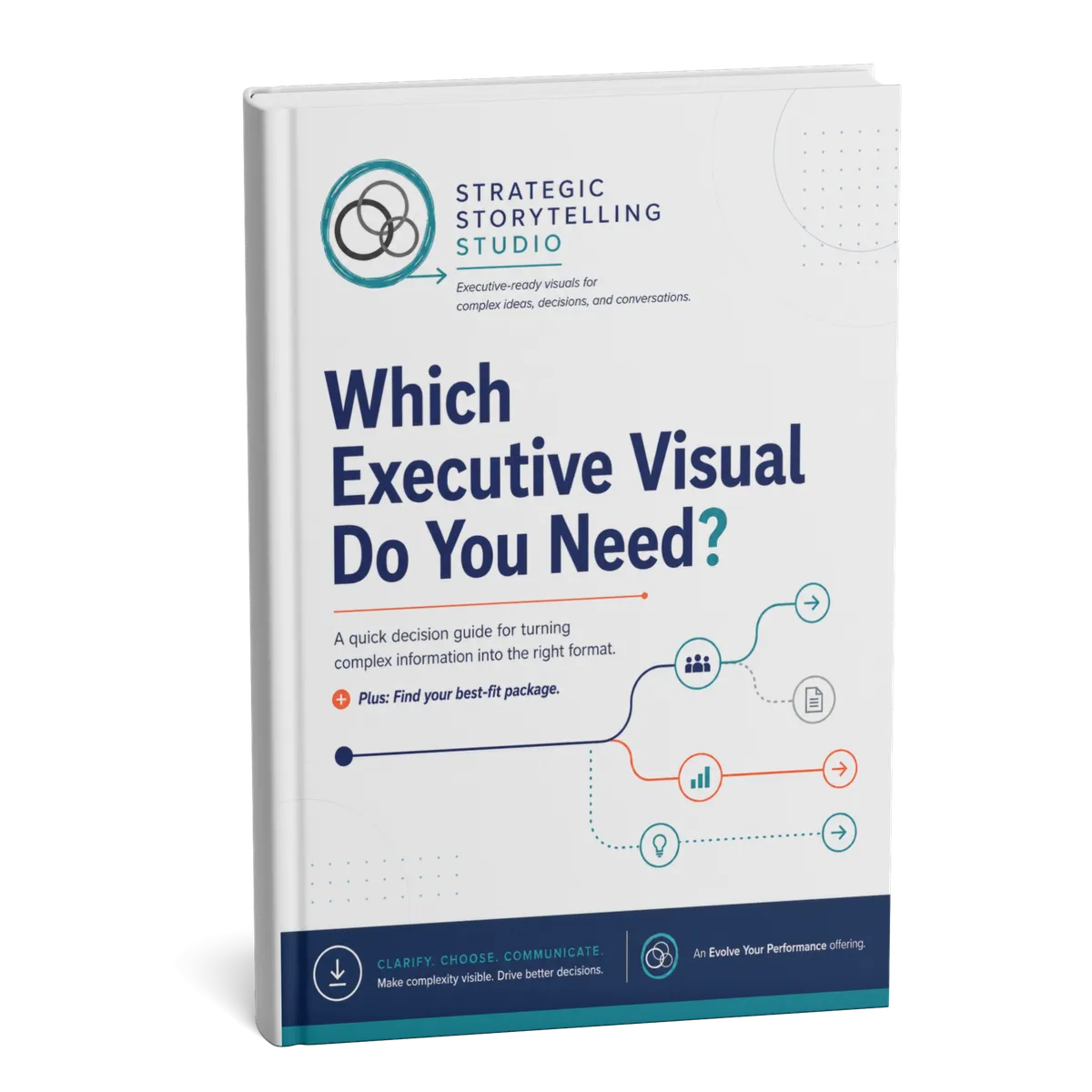
This free guide helps you choose the right kind of visual anchor for the conversation you need to lead, so the room can understand what matters, stay oriented, and move toward the right next step.
Use it to clarify the visual you need, and whether your situation fits Visualize, Shape, or Synthesize.
THE COST OF NO VISUAL ANCHOR
The problem is not always the content.
Sometimes the room needs something to anchor their focus.
Most important conversations come with too much information.
The deck has the background.
The report has the evidence.
The proposal has the rationale.
The strategy has the priorities.
The change message has the talking points.
The recommendation has the logic.
But the room still has to make meaning from it.
Without a visual anchor, people naturally gravitate to different pieces.
One person focuses on cost.
One person focuses on risk.
One person focuses on timeline.
One person focuses on politics.
One person jumps to implementation.
One person is still trying to understand what is being asked.
That is how a conversation loses momentum.
Not because people are careless.
Not because the work is weak.
Not because you did not explain enough.
Because there is no shared picture strong enough to anchor the focus of the room.
“Without a visual anchor to focus the room, shared sensemaking and shared language are left to chance.
That is how people agree in the moment and leave with different versions of the story.” — Dr. Mary Barnes
THE VISUAL ANCHOR
A visual anchor gives the room a place to focus.
A strong visual anchor is not decoration.
It is not a prettier slide.
It is not an infographic for its own sake.
It is not a template you drop information into and hope it works.
A visual anchor gives the room a shared surface for sensemaking.
It helps people see:
What matters most
How the pieces connect
What is changing
What decision is needed
What the findings mean
What approval would unlock
What each group needs to understand or do next
That shared view changes the conversation.
Instead of re-explaining the whole story verbally, you can point to the structure.
Instead of letting the room chase every detail, you can bring people back to the shared picture.
Instead of leaving with polite agreement and private confusion, people have something they can remember, repeat, and use.
START WITH THE ROOM
This guide helps you figure out what kind of visual you actually need.
Not every complex conversation needs the same kind of visual.
Sometimes you need a decision map.
Sometimes you need an approval anchor.
Sometimes you need an executive briefing visual.
Sometimes you need a strategy alignment map.
Sometimes you need a change sensemaking guide.
Sometimes you need a findings summary.
Sometimes your situation does not fit a neat category at all.
The guide helps you start with the right question:
What does the room need to do with the information?
Understand it?
Discuss it?
Decide from it?
Approve it?
Align around it?
Explain it to others?
Take action from it?
Once you know that, the right visual becomes much easier to identify.
THE GUIDE AT A GLANCE
Inside the free guide
The guide will help you think through:
What kind of room you are preparing for
What people need to understand before they can move forward
Where the conversation is most likely to drift
Whether the issue is a decision, approval, briefing, change, findings, strategy, or a custom situation
What kind of visual anchor could help
Whether your story is already clear or needs shaping first
Which Strategic Storytelling Studio package may fit your situation best
NOTE: You do not need to know the answer before you download the guide. That's the point of the guide.
WHEN THE STAKES MATTER
This is for you if...
This guide is for leaders, consultants, advisors, facilitators, evaluators, strategists, and teams who are carrying complex information into important rooms.
It is especially useful if:
You are tired of meetings where people talk around the issue but do not move forward
You have strong content, but the message still feels hard to land
You need leaders or stakeholders to see the whole picture faster
People keep saying they agree, but leave interpreting the work differently
You need a clearer way to explain a decision, approval request, finding, change, or strategy
You want a visual anchor that helps the room stay focused, aligned, and ready for the next step
IF YOU WANT HELP BUILDING IT
The guide can also help you choose the right level of support.
Strategic Storytelling Studio offers three levels of support.
Visualize the Story is for clear, mature content that mainly needs visual organization and polish.
Shape the Story is for content where the pieces exist, but the message needs clearer structure, hierarchy, and flow.
Synthesize the Story is for complex, high-stakes, sensitive, or still-forming stories that need strategic sensemaking before the visual is built.
The guide will help you see where your situation likely fits.
You can use it on your own, or use it to decide whether you want help turning your material into an executive-ready visual.
Give the room something shared to see.
Important conversations should not depend on people holding the whole story in their heads.
When the room needs to understand, discuss, decide, approve, align, or act, a visual anchor can make the complexity easier to grasp and the next step easier to see.
Download the free guide and start with the right question:
What does the room need to do with the information?
We make complexity visible.
We help people see the patterns.
We turn understanding into action.
That's executive storytelling.
An Evolve Your Performance offering.
© 2026 Evolve Your Performance, LLC
All rights reserved.