Choose the right level of support for your story.
THE VISUAL FORMAT IS ONE DECISION.
THE LEVEL OF THINKING SUPPORT IS ANOTHER.
Strategic Storytelling Studio helps turn complex information into executive-ready visuals for meetings, board packets, proposals, strategy conversations, findings, roadmaps, decision-making, and more.
Your final visual might be one of a dozen styles of one-pagers and placemats. The package you choose is not based on the final format of the visual. It is based on how clear the story is right now.
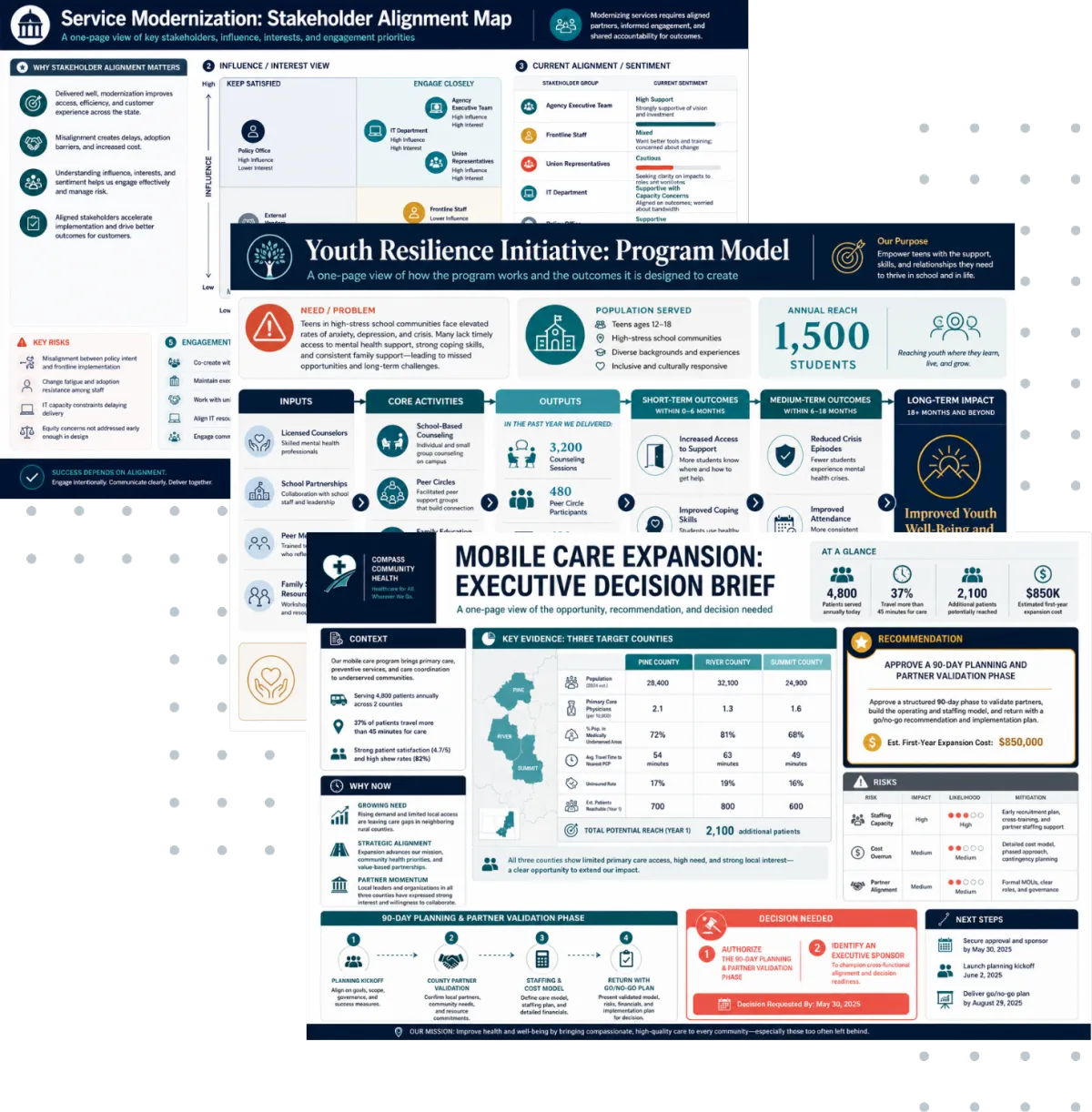
Which package do you need?
Use this decision tree to identify how much help you need before the visual gets built.
CLIENT PROOF
The same strengths behind the Studio work show up
across Mary's client work
Strategic Storytelling Studio is new as a productized offer, but the underlying work is not. Clients and colleagues have long pointed to the same pattern: Mary helps people clarify complexity, get to the heart of the matter, align around what matters, and move toward meaningful action.
“People have talked about goal alignment forever. But you communicate it so clearly and make it so simple.”
“They didn’t get to the heart of the matter like you did. We didn’t see as much of a change after they left like we did after you left.”
“Mary sits at the intersection of strategy, change, and impact.”
Feedback from prior Evolve Your Performance clients. Some excerpts have been shortened for clarity.
The three ways to work with Strategic Storytelling Studio
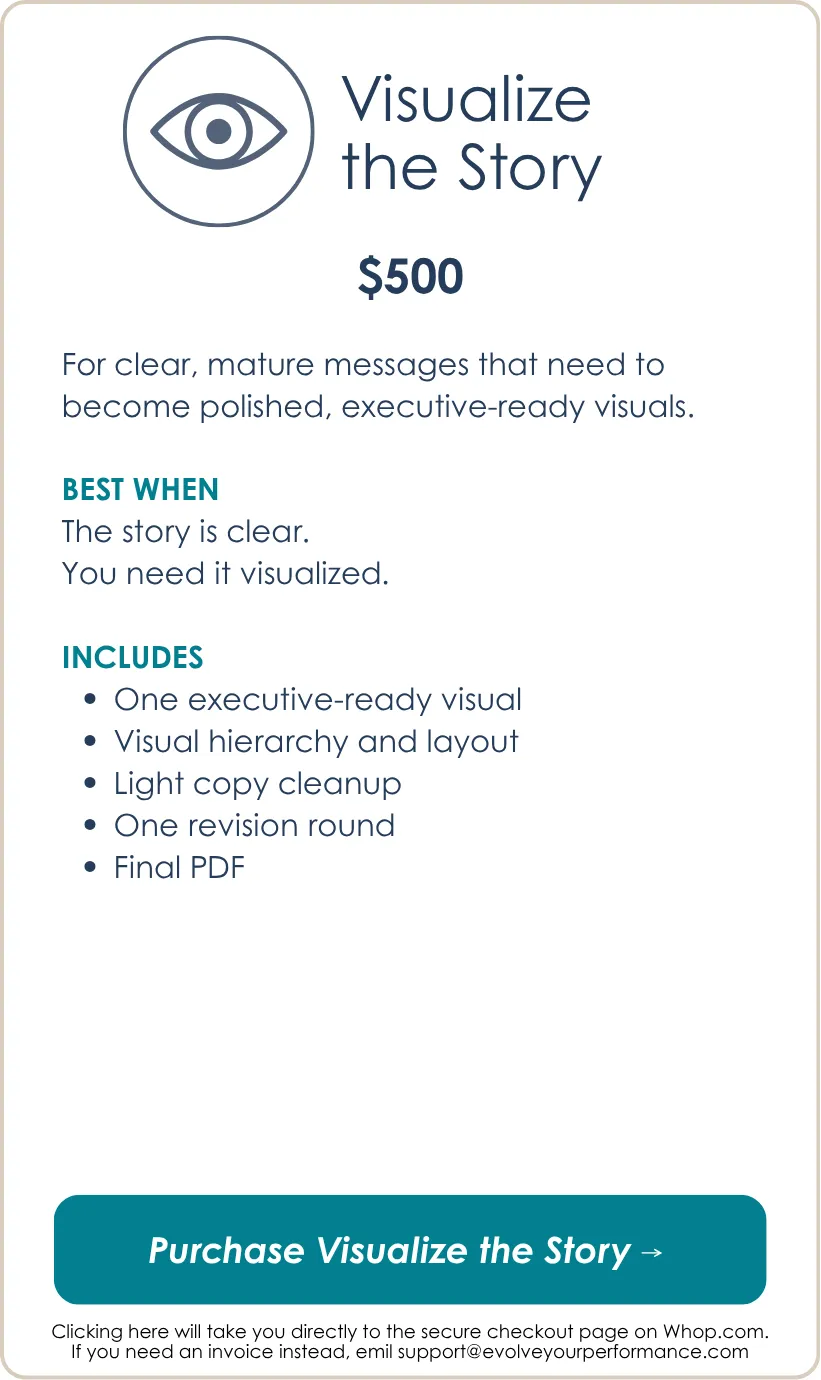

All packages include one revision round and a final PDF, ready for your meeting, board packet, proposal, client conversation, or leadership discussion.
Have questions? Check to see if they are answered below.
How do I know which package to choose?
Check out the decision tree image above. You basically need to decide how clear the story your are trying to tell is currently.
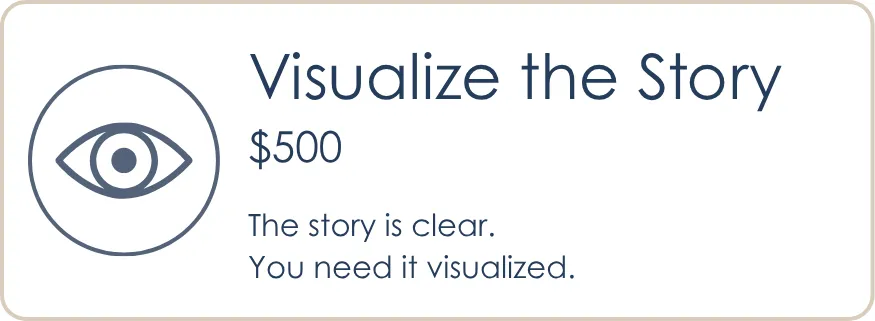
Choose Visualize the Story if your message, audience, purpose, and source content are already clear.
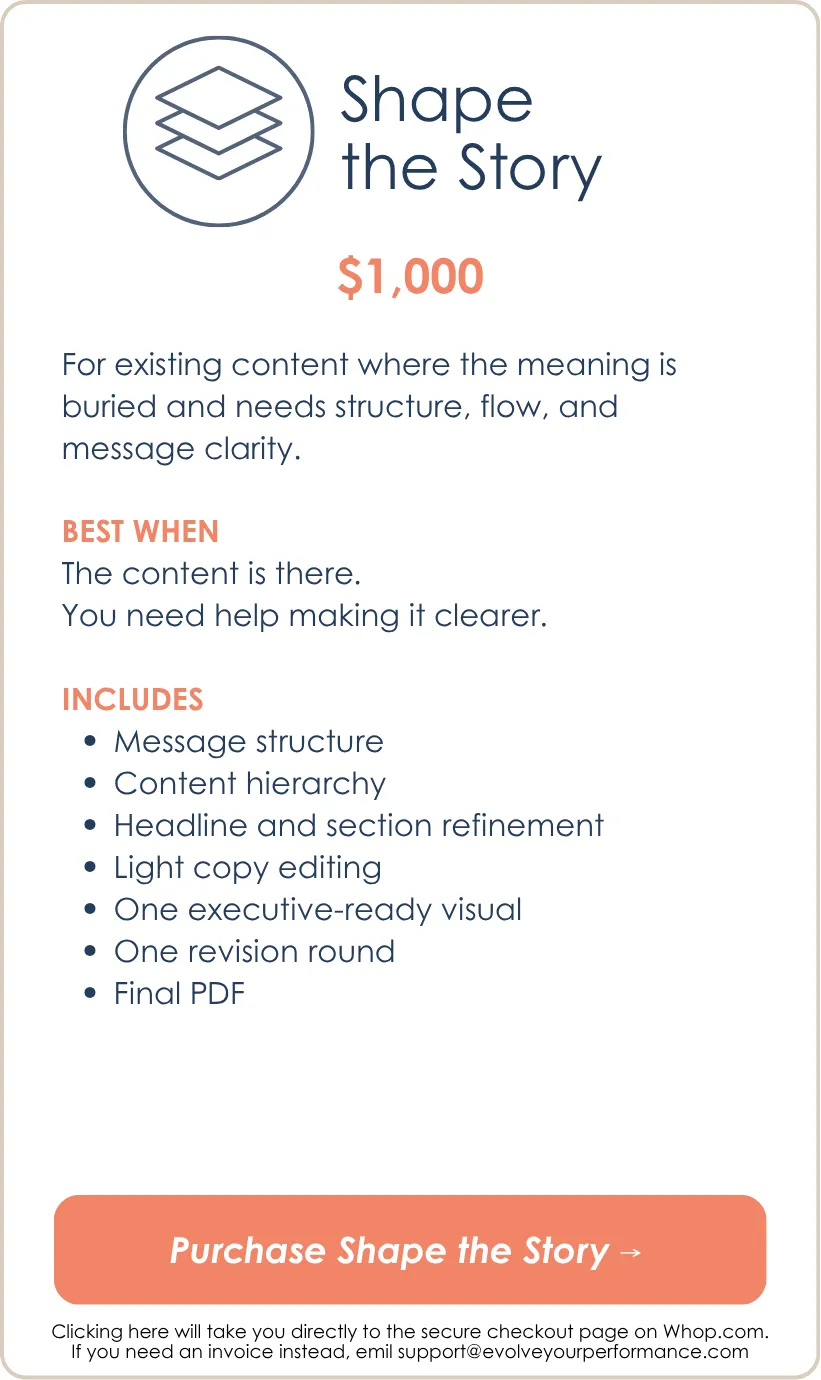
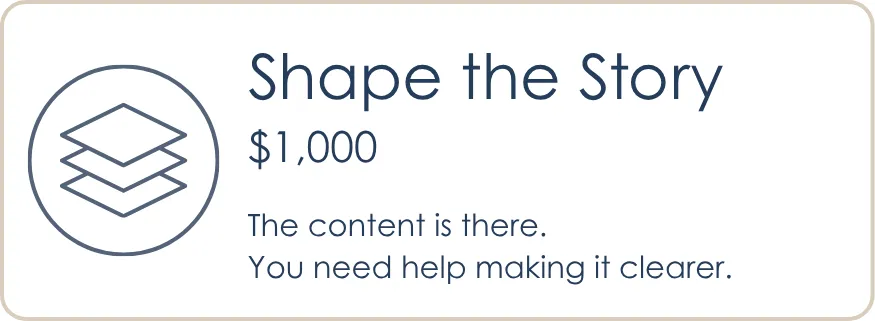
Choose Shape the Story if you have the content, but it needs better structure, hierarchy, flow, or message clarity.
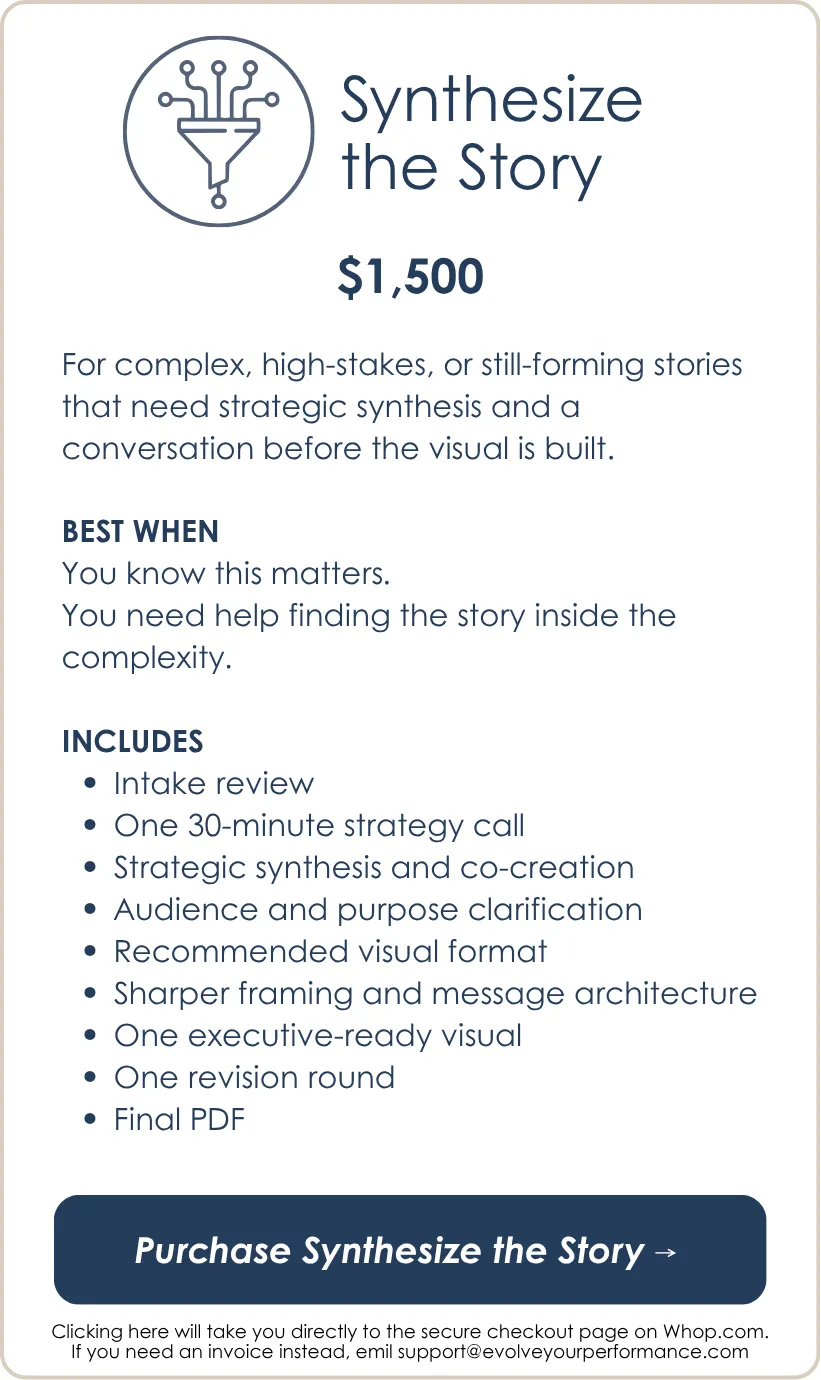
Choose Synthesize the Story if the issue is complex, high-stakes, messy, or still hard to frame. If you need a real-time conversation to talk through and co-create the story, this is the package you want.
The package is based on how much thinking support you need before the visual gets built.
What if I choose the wrong package?
The intake form helps clarify your audience, purpose, content, and intended use.
If your request appears to be significantly outside the package you selected, we’ll flag that before the build begins and recommend the right adjustment.
The goal is not to trap you in the wrong package.
The goal is to make sure the work is scoped correctly so the final visual is useful.
Do I need to know exactly what kind of visual I want?
No.
You do not need to arrive knowing whether you need a placemat, executive brief, decision map, roadmap, findings summary, board one-pager, or discussion guide.
You do need to know what you are trying to communicate, who the audience is, and what the visual needs to help them understand, discuss, decide, align around, or do.
The intake process helps clarify the best visual format for your situation.
Is this just graphic design?
No. Strategic Storytelling Studio is not a basic graphic design or Canva-polish service.
The work combines message structure, visual hierarchy, executive communication, and sensemaking.
The final artifact is visual, but the value is clarity: helping your audience understand the story faster, hold the meaning more easily, and use the information in a real conversation.
Why wouldn’t I just make this myself in PowerPoint or Canva?
You can. And if the story is simple, the audience is clear, and the stakes are low, that may be enough.
Strategic Storytelling Studio is useful when the visual needs to do more than look clean.
It needs to carry the right message, at the right level of detail, for the right audience, in a way that supports discussion, alignment, decision-making, or action.
The value is not just making the page look better.
It is the thinking behind the visual that makes the story easier to use.
What kinds of visuals can you create?
Possible outputs include:
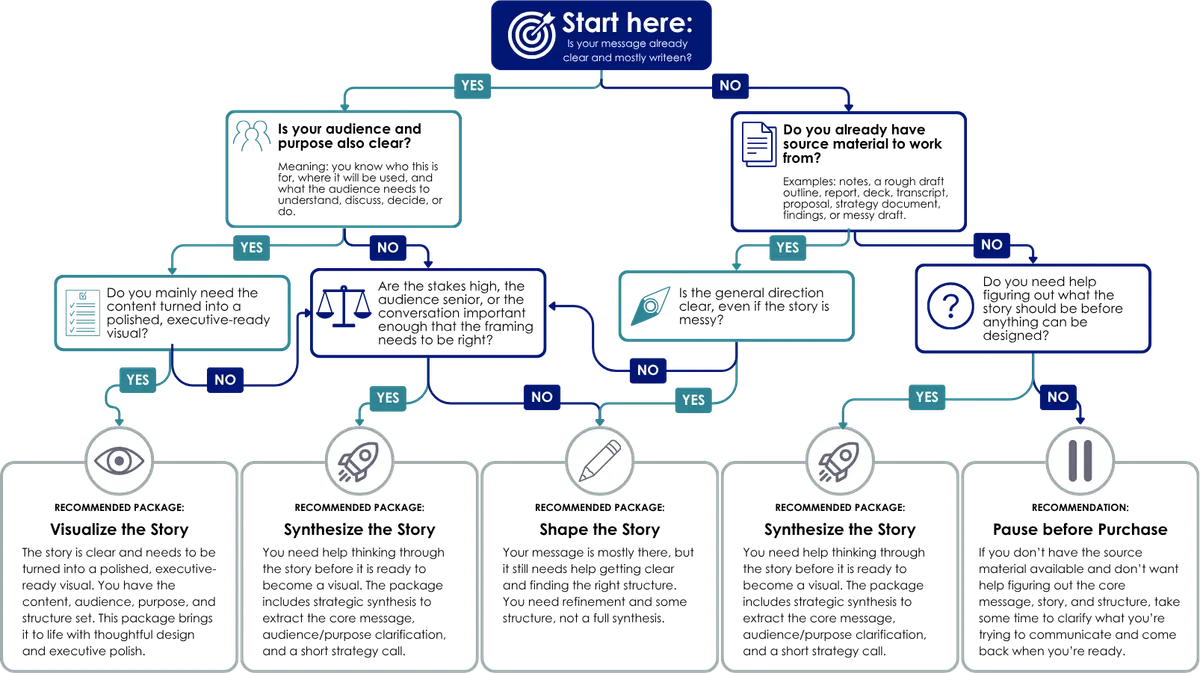
Strategic placemats
Executive briefs
Board one-pagers
Decision maps
Findings summaries
Change roadmaps
Program models
Operating model visuals
Meeting discussion guides
Implementation roadmaps
Stakeholder alignment maps
Theory of change visuals
Journey or process maps
Business case or proposal one-pagers
The right format depends on how the visual will be used and what the audience needs to do with the information.
What if my content is messy?
That depends on how messy.
If the content exists but needs structure, flow, and clearer language, Shape the Story is likely the best fit.
If the issue itself is still hard to frame, the stakes are high, or you need help finding the story inside the complexity, Synthesize the Story is likely the better fit.
If you already have final or near-final content, choose Visualize the Story.
What if I have too much information?
That is common.
The question is not, “How do we fit everything onto one page?”
The question is, “What does the audience need to see in order to have the right conversation?”
Some details may belong in the visual.
Others may belong in backup materials, an appendix, a report, or a follow-up document.
A strong executive visual does not include everything you know.
It creates the right view for the decision, discussion, or action needed.
What happens after I purchase?
After purchase, you will complete the intake form and upload your source materials and brand assets.
Once payment and completed intake are received, the project moves into review and build.
For Synthesize the Story, the strategy call must also be completed before the visual build begins.
You will receive one draft, one included revision round, and a final PDF.
When does work begin?
Work begins after payment and completed intake are received.
For Synthesize the Story, work begins after payment, completed intake, and the strategy call are complete.
This keeps the process clean, focused, and fair.
I’m not sure this is important enough to invest in.
That is exactly the right question to ask.
This may be worth investing in if the conversation affects a decision, funding, alignment, board confidence, client trust, stakeholder buy-in, implementation momentum, or strategic clarity.
If the visual is just decoration, you probably do not need this.
If the visual needs to help people understand, decide, align, or act, it may be worth doing well.
What if I only need something simple?
Then Visualize the Story may be enough.
Not every project needs deep synthesis or message shaping.
If your content is already clear and you simply need it translated into a polished, professional visual, the $500 package is designed for that.
What if I need help thinking through the story?
That is exactly what Synthesize the Story is for.
This package includes a 30-minute strategy call after purchase, plus strategic synthesis, audience and purpose clarification, recommended visual format, and sharper framing before the visual is built.
It is best for complex, high-stakes, or still-forming stories.
Can this replace a slide deck?
Sometimes.
A strategic visual can often replace a long opening explanation, guide a live conversation, summarize the core message, or serve as a leave-behind.
It may not replace every slide, chart, or supporting detail.
Instead, it gives the room a shared anchor so the conversation stays focused.
Can this support a longer report or proposal?
Yes.
Many executive visuals work best as a front-end guide to a longer document.
The visual helps the audience see the structure, meaning, recommendation, or decision path before they dive into the details.
It can be used as an executive summary, board snapshot, findings overview, proposal one-pager, or discussion guide.
What if I need this for a board, funder, or executive audience?
That is one of the strongest use cases.
Boards, funders, and executives usually do not need every detail you have.
They need the right view of the issue, decision, recommendation, tradeoffs, implications, or path forward.
Strategic Storytelling Studio helps shape the visual so it supports the level of conversation the audience actually needs to have.
What if my organization has strict branding?
Great.
You can upload brand assets through the intake form, including logos, colors, fonts, style guides, or examples.
The visual can be designed to feel aligned with your organization while still improving structure, clarity, and usability.
Can you use our existing language?
Yes.
The intake form asks what language must stay exactly as written and what language can be edited for clarity.
That matters when language has already been approved, carries legal or political sensitivity, or needs to remain consistent with formal documents.
Will you rewrite my content?
It depends on the package.
Visualize the Story includes light copy cleanup only.
Shape the Story includes message structure, content hierarchy, headline and section refinement, and light copy editing.
Synthesize the Story includes deeper strategic synthesis and message architecture before the visual is built.
None of the packages include full report writing, full organizational diagnosis, or unlimited rewriting.
Do you offer a call before purchase?
Not as part of the standard Studio process.
The Studio is designed as a focused, productized service.
If you need time with Mary to think through the story, choose Synthesize the Story. That package includes a 30-minute strategy call after purchase.
What does “one revision round” mean?
You will receive one draft and have one opportunity to provide consolidated feedback.
That revision round is used to refine the visual, correct issues, adjust language, and improve clarity within the agreed scope.
Additional revisions or major scope changes may require an add-on.
What if I need more than one visual?
Start with the visual that matters most.
Many clients begin with one executive-ready visual, then decide they need a companion version, slide adaptation, facilitation guide, implementation map, or additional one-pager.
Additional visuals can be scoped separately.
What file format will I receive?
The standard final deliverable is a PDF.
Depending on the project and any add-ons, additional file formats may be available.
We try to build the majority of the images in PPT because it is widely used and can be provided as an editable final version, where applicable.
The PDF is designed to be easy to share, print, attach to a board packet, use in a meeting, or send as a leave-behind.
Can I get the editable source file?
Editable source files are typically provided in PowerPoint (PPT) wherever possible because that format is readily accessible to almost everyone.
In some cases, certain elements may be imported as images to achieve the desired structure or visual clarity, and those elements may not be fully editable within PPT.
The standard package also includes the final PDF, giving you a polished artifact you can use immediately.
Can this be turned into slides later?
Yes.
A one-page visual can often become the foundation for a slide adaptation, executive briefing deck, or facilitation sequence.
That is a separate scope or add-on.
The one-page visual gives the story structure first, which often makes any follow-on slides much easier to build.
Is this right for internal use, or only client-facing materials?
Both.
Strategic visuals can support internal leadership meetings, board conversations, strategy sessions, staff communication, change management, program planning, client deliverables, funder conversations, and proposal support.
The key is whether the information needs to become clearer, more usable, and easier to discuss.
What if I don’t have all the information yet?
You may still be able to start, depending on what is missing.
If the missing pieces are minor, the intake process may be enough to help you pull the pieces together.
If the story is still forming or you need help making sense of incomplete information, Synthesize the Story is likely the better fit.
If too much is missing to build a useful visual, we’ll let you know before the build begins.
What if I’m embarrassed by how messy my content is?
Messy content is normal.
Most strong executive visuals start with too much information, unclear structure, scattered notes, dense reports, or a story that has not fully landed yet.
The point is not to judge the starting place.
The point is to create enough clarity that the audience can understand and use the information.
Besides, nothing can be worse that some of the spaghetti bowls of mess I've created for myself in the past! ;-)
How fast will I receive the visual?
Timeline depends on the package, project complexity, and how complete the intake materials are.
Work begins after payment and completed intake are received.
For Synthesize the Story, the strategy call must also be completed before the build begins.
The goal is to deliver a visual rough draft within 2 business days after payment and full intake (including the strategy call, if applicable) are complete.
You will get a specific timeline for your project based on capacity and completeness after your intake form has been reviewed.
What makes this different from hiring a designer?
A designer may make the page look better.
Strategic Storytelling Studio is focused on making the story work better.
That includes audience, purpose, message structure, visual hierarchy, and how the artifact will be used in the room.
The goal is not just a polished visual.
The goal is a clearer conversation.
What makes this different from hiring a consultant?
This is a focused, productized service.
It is not a full consulting engagement, organizational diagnosis, strategic planning process, or facilitation engagement.
It is a way to turn a specific idea, decision, report, recommendation, model, or conversation into an executive-ready visual.
If the work reveals a bigger need, deeper support can be scoped separately.
Can this help me sell an idea?
Yes, if the issue is appropriate for a visual.
A strong strategic visual can help a buyer, funder, board, executive, or stakeholder see the opportunity, recommendation, tradeoffs, evidence, and next step more clearly.
It does not replace the quality of the idea.
It helps the idea land.
What if the visual does not solve the bigger problem?
It might not.
Sometimes the visual reveals that the issue is bigger than communication.
There may be a strategy problem, alignment problem, operating model problem, change management problem, or decision-rights problem underneath.
In that case, the visual can still create clarity, and any deeper advisory support can be discussed separately if needed.
Is this created using AI?
The service is AI-enabled, but the work itself is not AI-generated.
The synthesis, structure, message architecture, and visual flow are human-powered.
The final visual is built manually to ensure clarity, precision, and a high-resolution, editable deliverable.
AI may support parts of the process behind the scenes, but the outcome is not an automated output. It is a crafted, executive-ready visual designed to be used in real conversations.
Ready to get started?
Pick the package that best meets your needs below and click to be taken to the secure checkout page.
We make complexity visible.
We help people see the patterns.
We turn understanding into action.
That's executive storytelling.
An Evolve Your Performance offering.
© 2026 Evolve Your Performance, LLC
All rights reserved.