
EXAMPLES WITHOUT THE TEMPLATE TRAP
You won't find a wall of finished visuals on this page.
Every Studio deliverable is built around one specific room, one specific audience, and one specific set of stakes.
Publishing client visuals as a gallery would make strategic sensemaking look like a template library. That is not how this work creates impact.
So instead of showing you finished client work to copy, this page shows what matters more: the kind of feedback the work earns, how I use the same thinking myself, and what sample builds can look like (using generic scenarios for illustration purposes).
The feedback that tells us the visual did its job
People do not usually say things like this because a slide looked nice. They say it because the visual helped the room make sense of something that had been hard to hold.
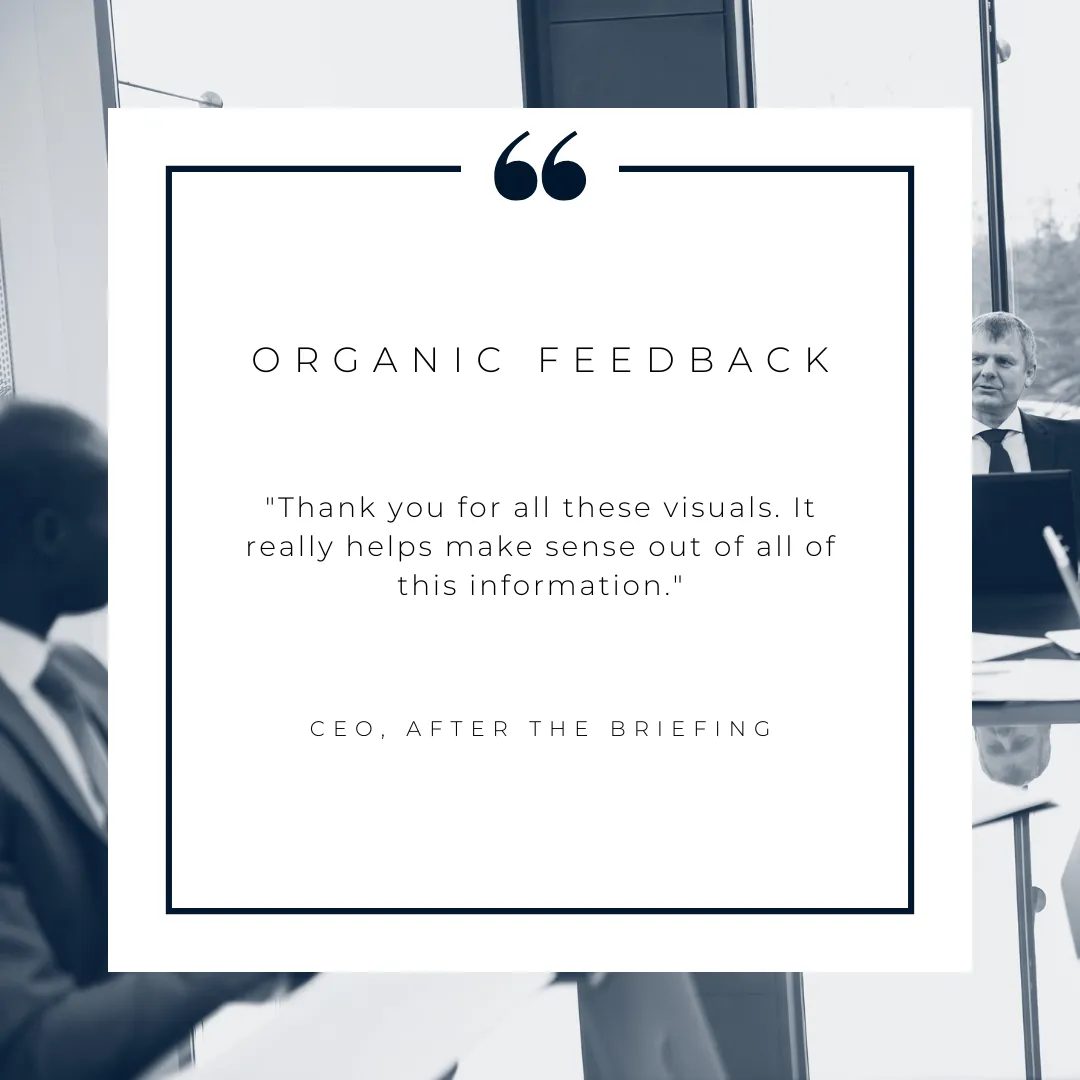
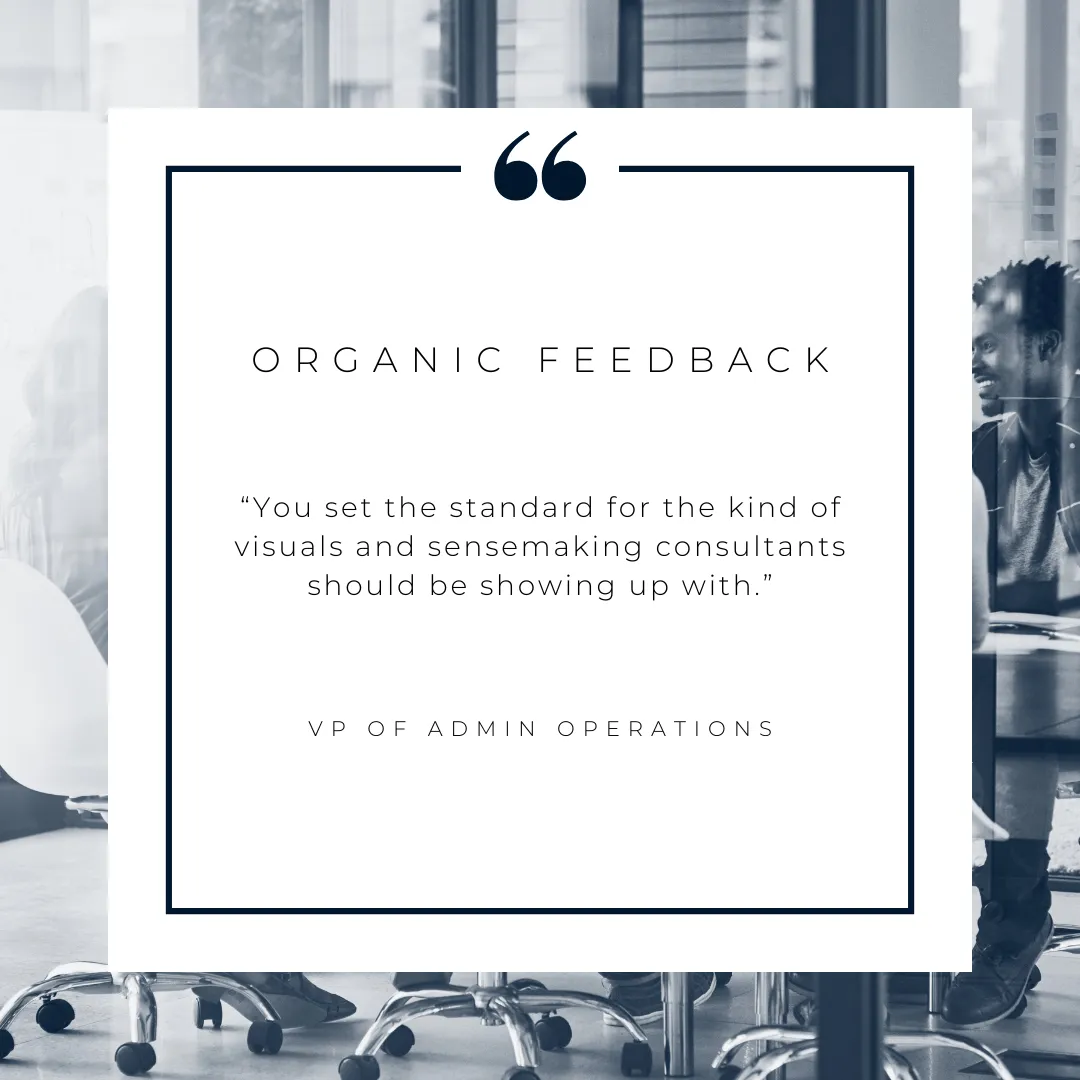
Shared with permission. Names withheld to protect confidentiality.
How I use this myself
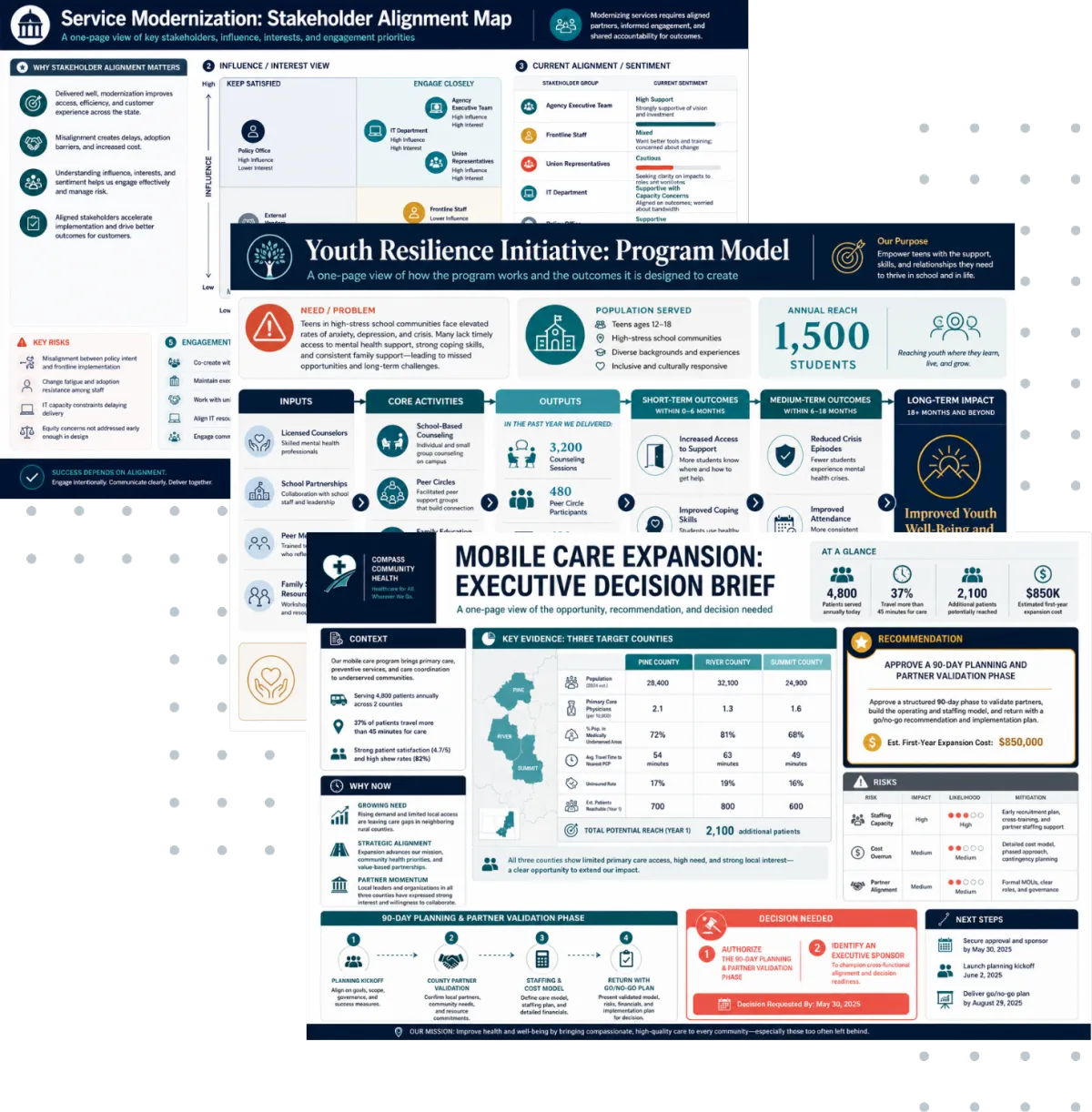
Strategic Storytelling Studio exists because I use this kind of sensemaking in my own work, not only in client work.
This is not a client case study. It is a look at the same underlying discipline turned on my own business: taking messy, multi-threaded work and giving it a visual structure I can actually use.
No client data. No confidential case study. Just the same sensemaking discipline applied to my own work.
What the work actually looks like
Three sample builds so you can see the difference in starting point, scope, and sensemaking support.
These are not client materials, and they are not templates.
They are designed to show how the work changes depending on the starting point:
Visualize the Story starts with a clear message that needs visual organization and polish.
Shape the Story starts with useful material that needs stronger structure, hierarchy, and flow.
Synthesize the Story starts with complexity that needs strategic sensemaking before the visual can be built.
The difference is not simply how polished the final visual looks.
The difference is how much thinking has to happen before the design can do its job.
As you watch the samples, don’t look for the exact layout you want. Look for the starting condition.
Do you already know the story and need it visualized?
Do you have the pieces, but need the message shaped?
Or is the story still complex, high-stakes, or unresolved enough that it needs synthesis first?
Card 1: Visualize the Story
A department head has a clear reorganization message and needs to explain it to the team in a clean, visual way.
Card 2: Shape the Story
A consultant has synthesized their interview notes into findings and a core message, but needs help turning them into a clear, compelling findings summary.
Card 3: Synthesize the Story
A leadership team needs a board-ready decision map for a make-or-buy conversation where the story needs work.
ONE MORE THING WORTH KNOWING
Why we don't publish client work or sell templates
Nothing here is a template you can drop your content into. That is intentional.
The value of a Studio visual is not the layout by itself. The value is the sensemaking that happens before the design: clarifying the room, the audience, the stakes, the message, the friction points, and what people need to understand, discuss, decide, approve, align around, or do next.
The design comes after that.
For Visualize the Story and Shape the Story, the intake form helps surface that sensemaking. It asks the questions that clarify what the visual needs to do before anything gets designed.
For Synthesize the Story, the intake form and strategy call go deeper. Together, they help shape the logic, message, structure, and meaning before the visual build begins.
In every package, the final deliverable is not just a pretty design on a large sheet of paper.
It is a visual representation of the thinking underneath it.
That is why client work is not useful as a public gallery. Each visual was built for one specific room, one specific audience, and one specific set of stakes. It worked because it was shaped around that situation. Copying the layout onto a different problem would miss the point.
If you want to see how this thinking applies to your situation, the fastest way to start is with your own material, not someone else’s finished deck.
The visual is not the product. The sensemaking is. The visual is how that sensemaking becomes usable in the room.
Ready to see what this looks like for your story?
Start with the package that matches where your story is right now: clear and ready to visualize, mostly there but needing shape, or complex enough to need synthesis first.
Still deciding? Download the free guide to clarify the kind of visual your situation needs and which Studio package is the best fit.
We make complexity visible.
We help people see the patterns.
We turn understanding into action.
That's executive storytelling.
An Evolve Your Performance offering.
© 2026 Evolve Your Performance, LLC
All rights reserved.