
WHEN EXECUTIVES NEED THE STORY, NOT THE WHOLE DOWNLOAD
Give executives the story to remember and the message to carry forward.
You do not need to tell executives everything you know. You need to give them the right view of the issue, the narrative you need them to understand, the talking points you want them to reinforce, and the clear asks that will help move the work forward.
A strong executive briefing visual turns complexity into a usable leadership message.
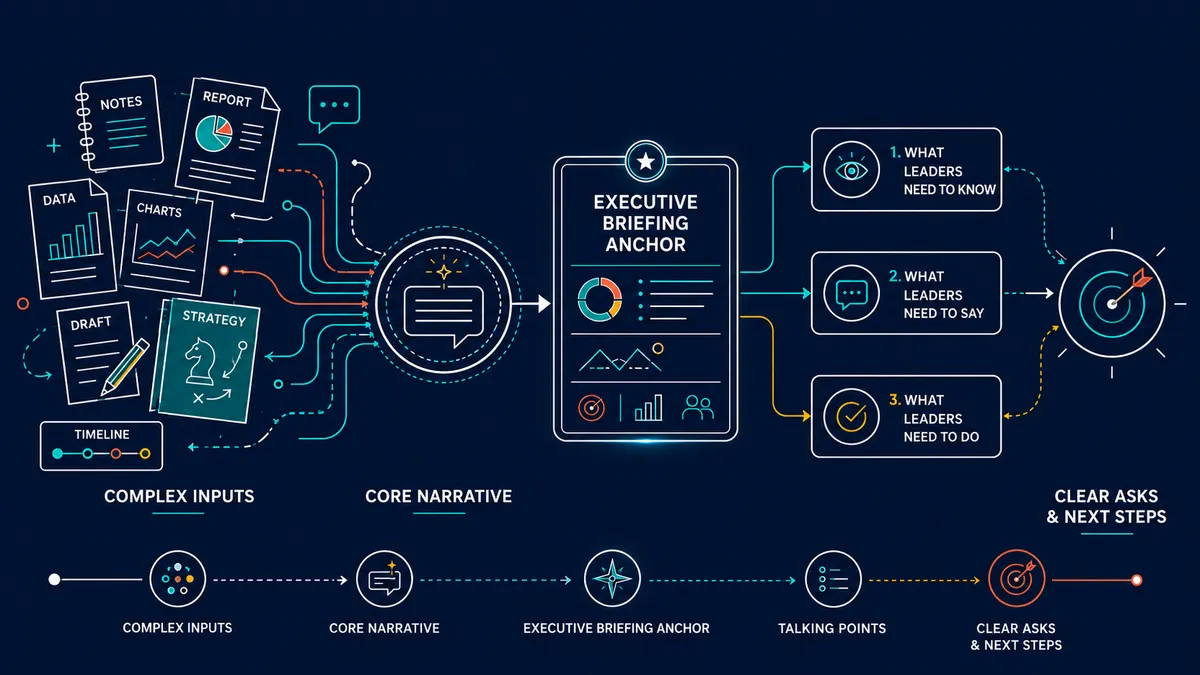
Executives do not need more information.
They need the right story.
You may be preparing for a leadership update, board prep, initiative briefing, strategy conversation, change message, client-facing narrative, or internal alignment moment.
The stakes may not be dramatic.
But the room still matters.
Because once executives hear the story, they rarely keep it in the room.
They repeat it.
Summarize it.
Pressure-test it.
Ask questions about it.
Translate it to their teams.
Use it with board members, funders, stakeholders, clients, staff, or partners.
That means the briefing is not only about what executives understand.
It is also about what they carry forward.
If the message is muddy, it travels badly.
If the ask is buried, it gets missed.
If the context is too dense, leaders fill in the gaps themselves.
If the talking points are not clear, five executives may leave with five slightly different versions of the story.
That is where an executive briefing visual anchor helps.
It gives leaders the right amount of context, the core narrative, the message you want reinforced, and the clear asks needed to move the work forward.
Not everything.
The right things.
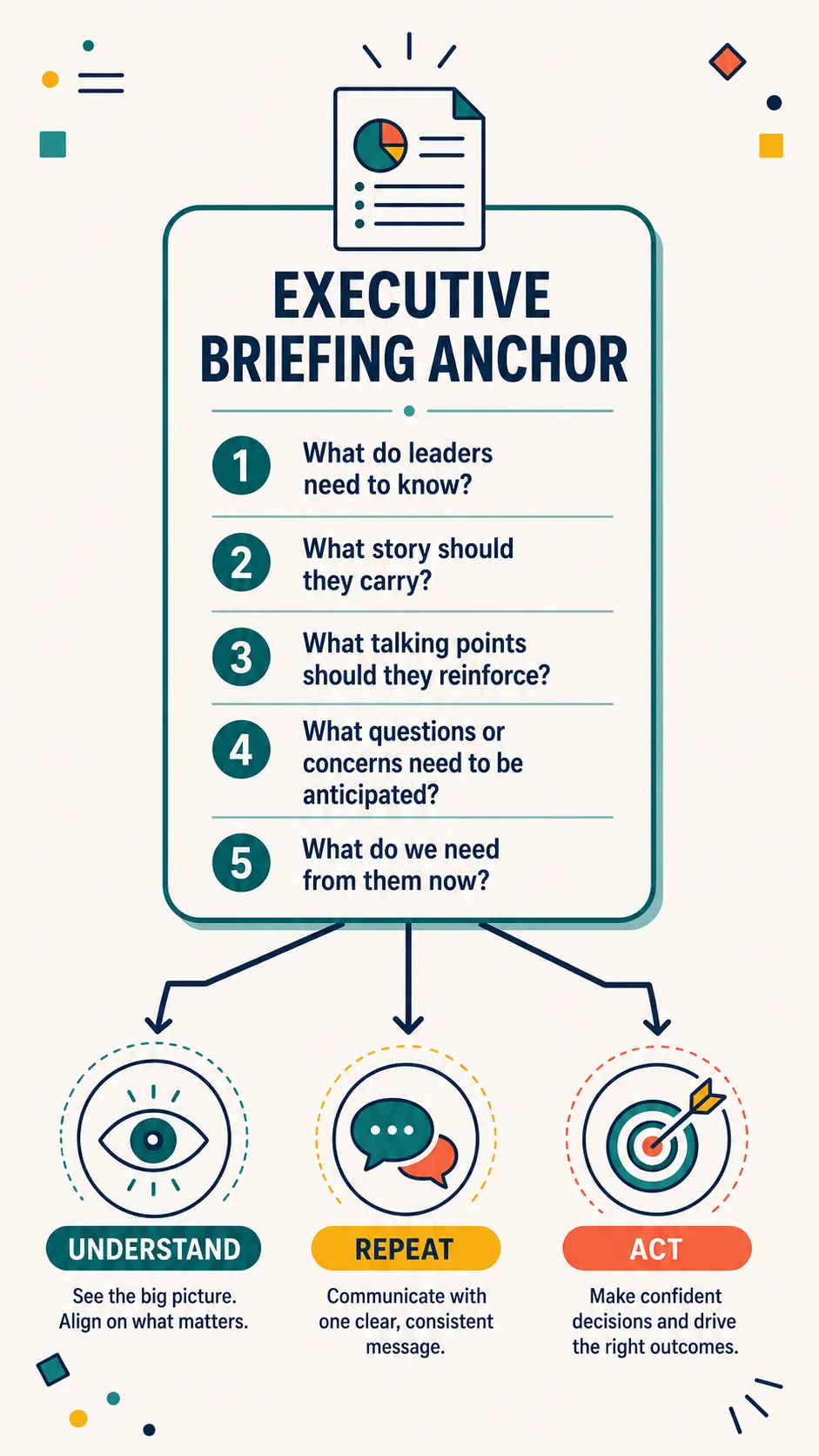
I LEARNED THIS THE HARD WAY
I used to think a good briefing meant ALL the context.
For a long time when I briefed executives, I tried to make sure they had the full picture.
The background.
The data.
The timeline.
The risks.
The status.
The context behind the context.
The nuance behind the nuance.
I wanted them to feel informed.
And because I knew how much complexity sat underneath the issue, I kept adding more.
Another slide.
Another caveat.
Another supporting point.
Another "you should also know."
The briefing was always accurate.
But accuracy was not enough.
Sometimes leaders walked away with different versions of the message.
Sometimes the most important point got buried in the context.
Sometimes the ask showed up too early or too late.
Sometimes the executive team understood the issue intellectually, but didn't know what language to use when someone asked about it later.
That creates cleanup.
You end up clarifying what was meant.
Correcting the message after it has already traveled.
Answering the same questions in five different conversations.
Trying to rebuild alignment after leaders have already started communicated from slightly different scripts.
Eventually, I realized the problem:
I had prepared the briefing.
But I had not prepared the message for travel.
THE SHIFT
The visual anchor changed what executives could do with the story.
It gave me a clear structure for shaping the briefing. A way to focus not just on what I wanted to say, but on what leaders needed to walk away with.
It kept the message tight and intentional. Grounded in what mattered most, without drifting into unnecessary detail or losing the thread.
And it made the outcome explicit. Not just understanding, but alignment and action.
Once I started using this kind of anchor, I stopped thinking of executive briefings as information delivery.
I started thinking of them as moments to shape how leaders understand, repeat, and act.
The question is not,
"What do executives need to know?"
The better question is:
"What do executives need to understand, share, and do?"
WHAT A VISUAL ANCHOR CAN MAKE EASIER
A strong briefing anchor helps leaders leave with the same story.
Executive briefings can get messy because leaders are listening through different filters.
One person is thinking about risk.
Another is thinking about budget.
Another is thinking about politics.
Another is thinking about staff impact.
Another is already imagining the stakeholder reaction.
None of that is wrong.
It is how executive rooms work.
The briefing visual gives the room a shared center.
A strong executive briefing anchor can help leaders:
See the main narrative faster
Understand why the issue matters now
Separate signal from noise
Recognize what message needs to travel
Carry consistent talking points into other rooms
Anticipate likely question or concerns
Understand what support, decision, protection, or action is being requested
Leave with a clearer sense of what happens next
This is not about making the briefing prettier.
It's about making the message easier to carry.
WHAT THIS CAN BECOME
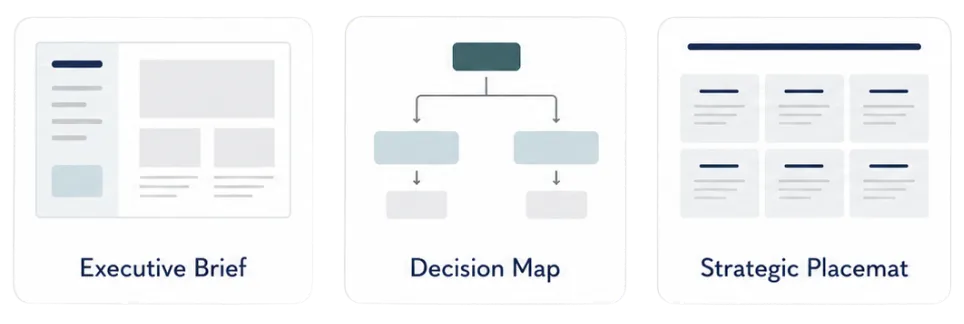
The format follows the job of the briefing.
Once we understand your audience, purpose, source material, and desired outcome, we shape the briefing structure around the conversation it needs to support.
You do not need to force your story into a template.
We build the visual around what the room needs to see, understand, and do.

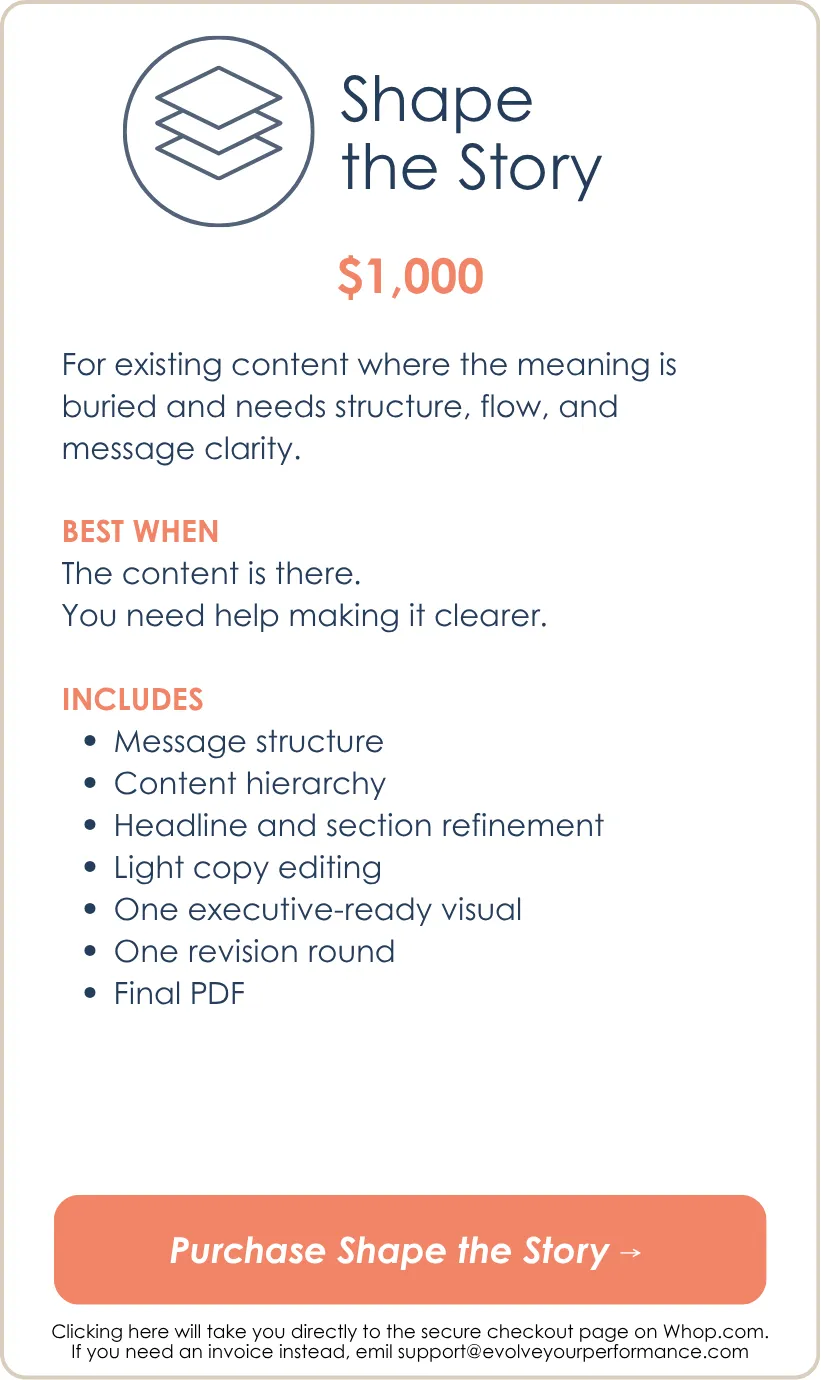
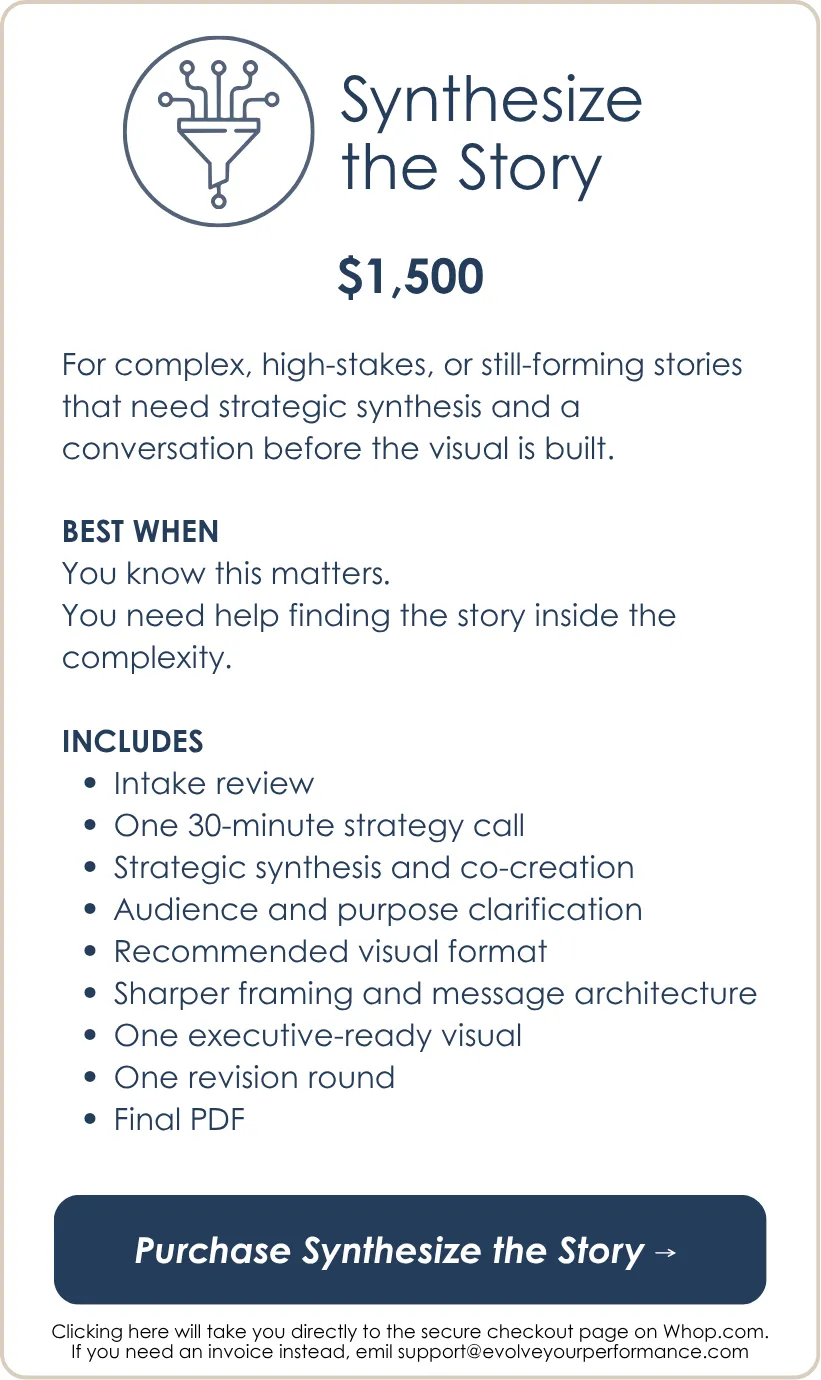
CHOOSE YOUR LEVEL OF SUPPORT
Choose based on how clear the story is right now.
Pick the level of support that matches where you are in the process.

WHAT HAPPENS NEXT
The process is simple.
NOTE: Work begins after payment and completed intake are received.



A few questions before you choose
What if I already have an executive summary?
That helps, but an executive summary and an executive briefing anchor do different jobs.
An executive summary usually condenses information.
An executive briefing anchor helps leaders understand the narrative, remember the message, carry the talking points, and take action on the ask.
What if the briefing is mostly informational?
That can still be a strong fit.
Even informational briefings have a job. Leaders may need to understand context, prepare for stakeholder questions, align around language, notice risks, or know what is coming next.
The visual helps clarify what executives need to take away, even if no formal decision is required.
What if I need executives to repeat the message consistently?
That is one of the best reasons to create a visual briefing anchor.
If leaders are going to cascade the message to teams, stakeholders, board members, clients, or partners, they need more than just background information. They need a shared narrative and clear talking points.
A briefing visual can help reduce message drift before it starts.
What if there are clear asks for the executives?
Good.
The asks should not be buried.
They may include approval, sponsorship, protection, resources, communication support, stakeholder outreach, decision-making, prioritization, or alignment. The visual can make those asks visible and tied to the story.
What if the topic is sensitive?
Sensitive topics need careful message architecture.
The intake form asks what language must stay exactly as written and what can be clarified. This matters for legal, policy, personnel, public-facing, reputational, political, funder, or stakeholder-sensitive issues.
For sensitive briefings, Synthesize the Story is usually the better fit because the framing matters as much as the design.
If non-disclosure agreements (NDA) are needed, we are happy to sign one that would protect any sensitive information from being shared. All information is saved on password-protected devices and is never distributed outside the scope of our work.
What if the executives are not fully aligned yet?
Then the visual may need to support alignment before cascade.
Sometimes the purpose of the briefing is not only to inform. It is to get the executive group working from the same story before they carry it elsewhere.
That may mean clarifying the narrative, surfacing tensions, tightening the talking points, and identifying what must be decided or agreed upon before broader communication happens.
What if my content is messy?
Messy content is normal.
If the content exists but needs structure, choose Shape the Story.
If the story itself is still hard to frame, choose Synthesize the Story.
If the content is already clear, choose Visualize the Story.
What if I have too much information?
That is common.
The goal is not to fit everything onto one page.
The goal is to create the right view for the conversation.
Some details may belong in the visual. Others may belong in backup materials, an appendix, or the full report.
What if I choose the wrong package?
The package is based on how much thinking support you need before the visual gets built.
If your request appears to be significantly outside the package you selected, we will flag that before the build begins and recommend the right adjustment.
The goal is to make sure the work is scoped correctly so the final visual is useful.
Is this just graphic design?
No.
The final artifact is visual, but the work is not just design.
It is message structure, sensemaking, visual hierarchy, and executive communication.
The goal is not just a better-looking page.
The goal is a clearer conversation.

Ready to give executives a clearer story to carry?
You do not need another briefing where the main point gets buried, the ask gets missed, or leaders leave with five different versions of the story.
If the message matters, executives need a clear visual anchor they can understand quickly, use in the room, and carry into the conversations that follow.
Choose the level of support that fits where your briefing story is now, and we will help turn the complexity into an executive-ready visual people can actually use.
Still thinking it through? Check out the How it Works page to learn more and download the free guide.
We make complexity visible.
We help people see the patterns.
We turn understanding into action.
That's executive storytelling.
An Evolve Your Performance offering.
© 2026 Evolve Your Performance, LLC
All rights reserved.