WHEN EVERYONE NEEDS TO SEE THE SAME PATH FORWARD
Strategic alignment needs more than a shared document.
You may have the vision, priorities, initiatives, and plan. But if leaders and teams are interpreting the strategy differently, pulling in different directions, or unclear on how their work contributes, the strategy will fragment in execution.
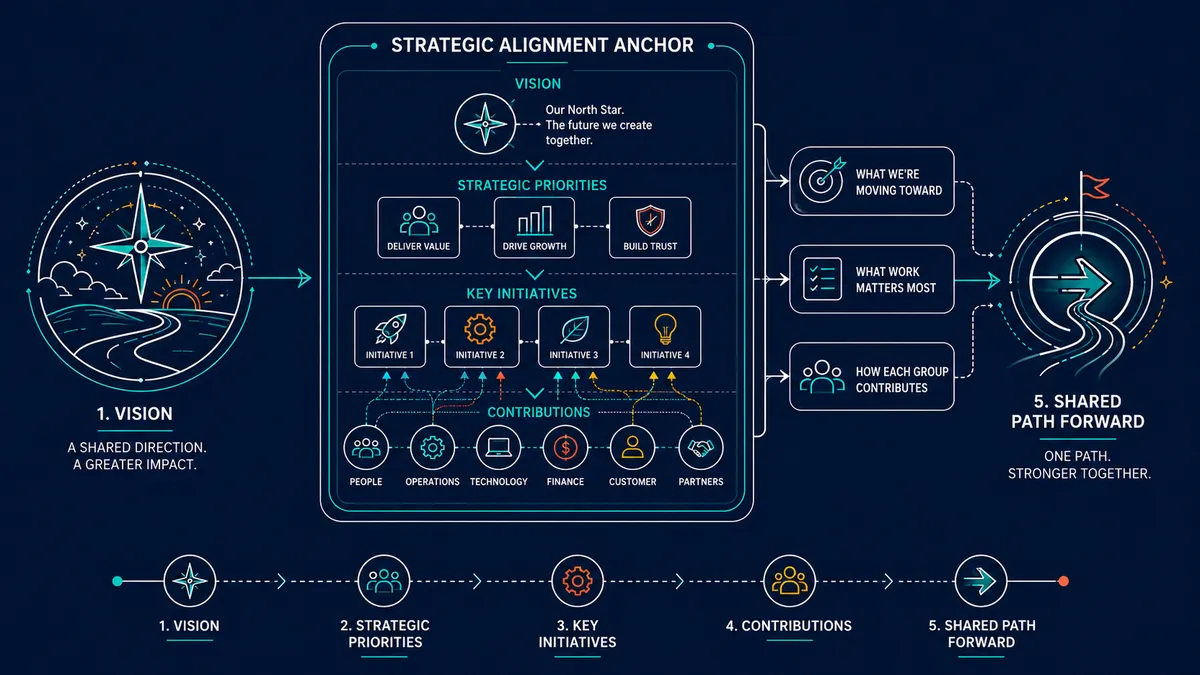
A strong strategic alignment visual gives the room a shared picture of where you’re going, what matters most, how the work connects, and how each group contributes to the path forward
The strategy may be clear on paper.
That does not mean people are aligned in practice.
You may be preparing for a leadership meeting, strategy rollout, board discussion, planning session, team offsite, transformation update, or cross-functional alignment conversation.
You may already have the strategic plan.
The vision.
The priorities.
The initiatives.
The goals.
The measures.
The roadmap.
The deck.
And still, something feels off.
People agree in the meeting, but interpret the strategy differently afterward.
Teams nod at the same words, but picture different work.
Leaders say the priorities are clear, then keep protecting their own lanes.
Initiatives multiply until everything sounds strategic.
People want to contribute, but cannot see where their piece fits.
That is where a strategic alignment visual anchor helps.
It gives the room a shared way to see the strategy as a system.
Not as a list of initiatives.
Not as a slide deck.
Not as a slogan.
Not as a set of disconnected priorities.
As a clear path forward.
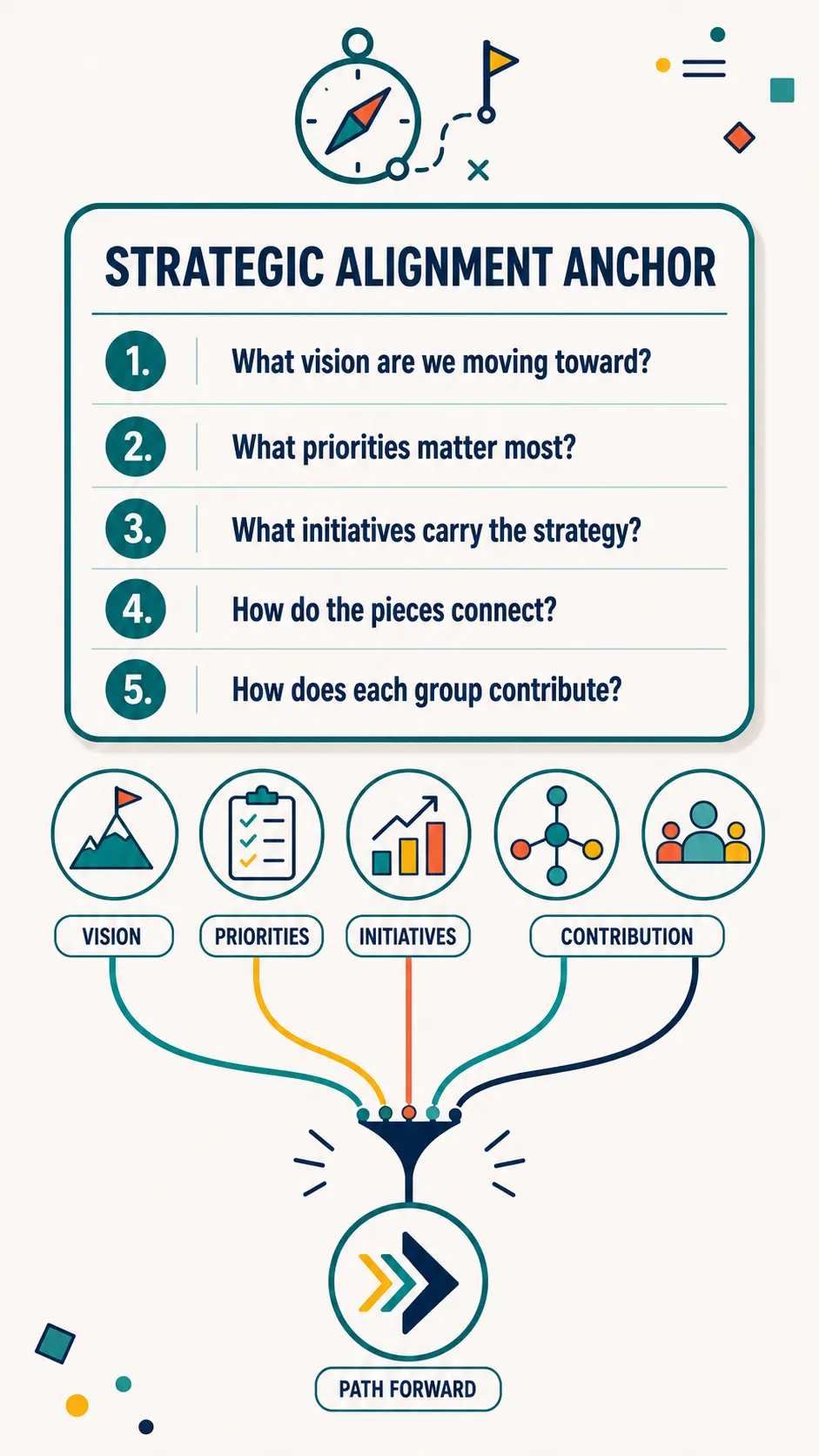
A strong visual anchor helps people see the vision, the priorities, the major bodies of work, the relationships between them, and the role different teams play in advancing the whole effort.
Because strategy does not create alignment because it exists.
It creates alignment when people can see it, understand it, talk about it, and locate themselves inside it.
I LEARNED THIS THE HARD WAY
I used to think alignment meant that a strategy merely existed.
For a long time, I thought strategic alignment happened when the strategy was explained clearly enough.
So I would prepare the materials.
The strategic plan.
The priorities.
The goals.
The roadmap.
The talking points.
The leadership message.
I would walk people through the logic:
Here is where we are.
Here is where we are going.
Here are the priorities.
Here are the initiatives.
Here is what happens next.
In the room, it would feel like alignment.
People nodded.
People agreed.
People said the right things.
People understood the words.
Then... execution started.
And, the cracks showed up:
One team assumed they owned an entire strategic pillar and became difficult to collaborate with.
Another tried to repackage their existing projects as strategic initiatives.
One leader pulled their team into a side effort that felt more advantageous for their own trajectory.
Another team felt left out of the strategy entirely and started to question whether their work mattered.
Nobody was trying to sabotage the strategy.
They were translating it through their own lens.
That is the quiet danger of strategic misalignment.
It often does not look like conflict at first.
It looks like polite agreement followed by scattered execution.
Eventually, I realized the problem:
I had presented the strategy.
But I had not created a shared picture.
Without that shared picture,
people were filling in the gap themselves.
THE SHIFT
The visual anchor changed how people found themselves in the strategy.
Once I started using visual anchors for strategic alignment, the conversation changed.
The strategy stopped being a set of words people had to interpret.
It became something the room could see.
People could point to the vision.
See the priorities.
Trace the initiatives.
Notice the dependencies.
Understand what belonged where.
Ask better questions about what mattered most.
See how their work connected to the larger direction.
The visual did not create alignment by itself.
But it gave the room a shared surface for alignment to happen.
It made the strategy easier to discuss without losing the thread.
It helped people move from “I understand the words” to “I see the path.”
And that is the difference that matters.
Because alignment is not agreement in the abstract.
Alignment is shared direction, shared meaning, and coordinated movement.
The question is not,
"Does everyone know the strategy?"
The better question is:
"Can people see where we're going, what matters most, and how their work contributes?"
WHAT A VISUAL ANCHOR CAN MAKE EASIER
A strong visual anchor helps people align around the same path, not just the same words.
Strategy conversations get messy because everyone listens from where they sit.
Executives hear enterprise priorities.
Division leaders hear tradeoffs.
Managers hear workload.
Teams hear change.
Partners hear dependencies.
Stakeholders hear risk, impact, or timing.
None of that is wrong.
It is how strategy moves through a real organization.
The problem comes when those perspectives never get connected back to one shared picture.
A strong strategic alignment visual can help the room:
See the vision in plain language
Understand what strategic priorities matter most
Recognize which initiatives carry the strategy
See how workstreams connect across functions or teams
Separate true strategic priorities from activity and noise
Clarify how each group contributes to the larger direction
Surface gaps, overlaps, dependencies, or tensions
Keep the conversation at the right level of altitude
Create a shared reference point for ongoing execution
This is not about making the strategy prettier.
It is about making the path forward easier to see and harder to fragment.
WHAT THIS CAN BECOME
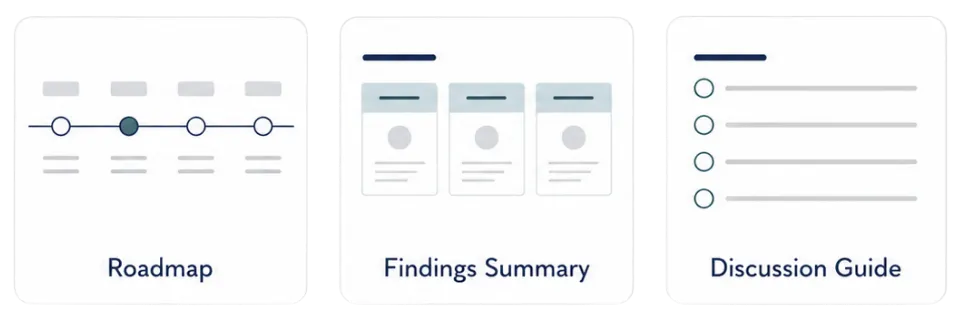
The format follows the job of the visual.
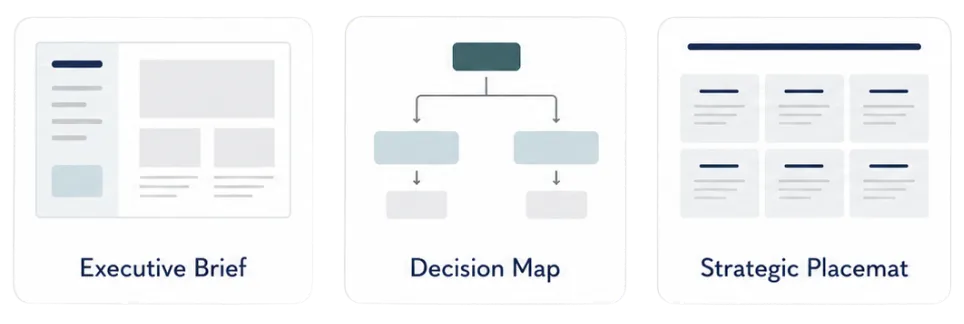
Once we understand your audience, purpose, source material, strategy, and desired outcome, we shape the visual structure around the alignment conversation it needs to support.
You do not need to force your story into a template.
We build the visual around what the room needs to see, understand, and do.
CHOOSE YOUR LEVEL OF SUPPORT
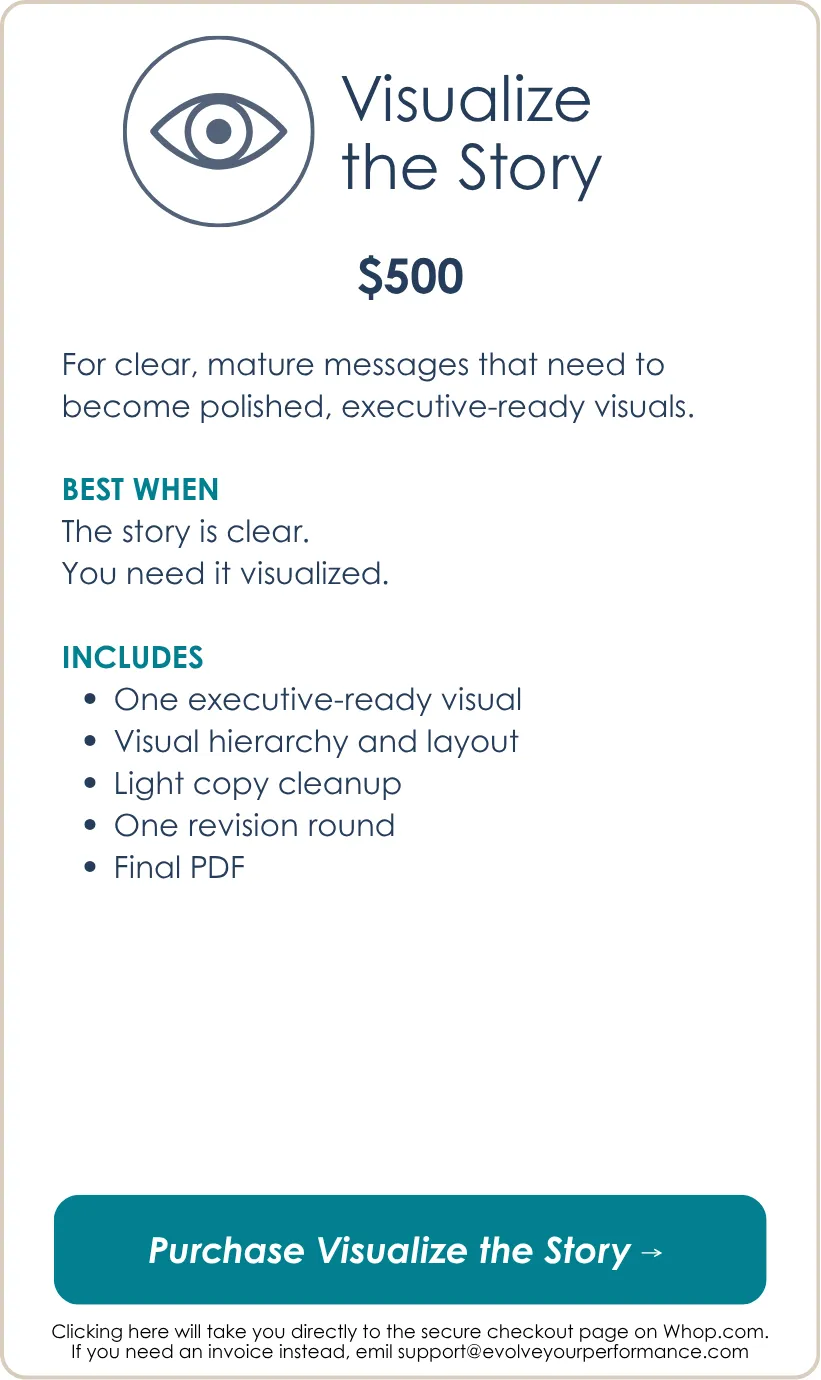
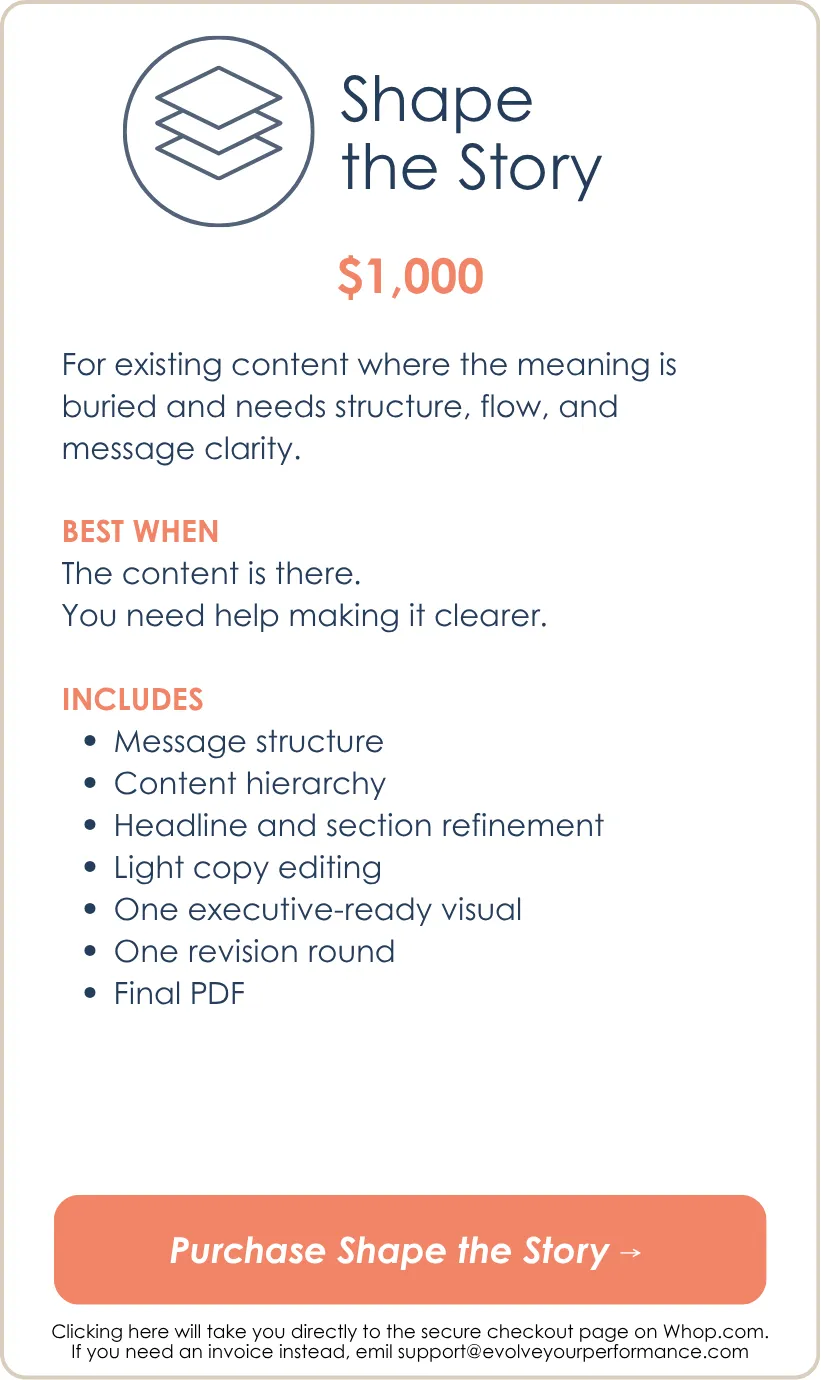
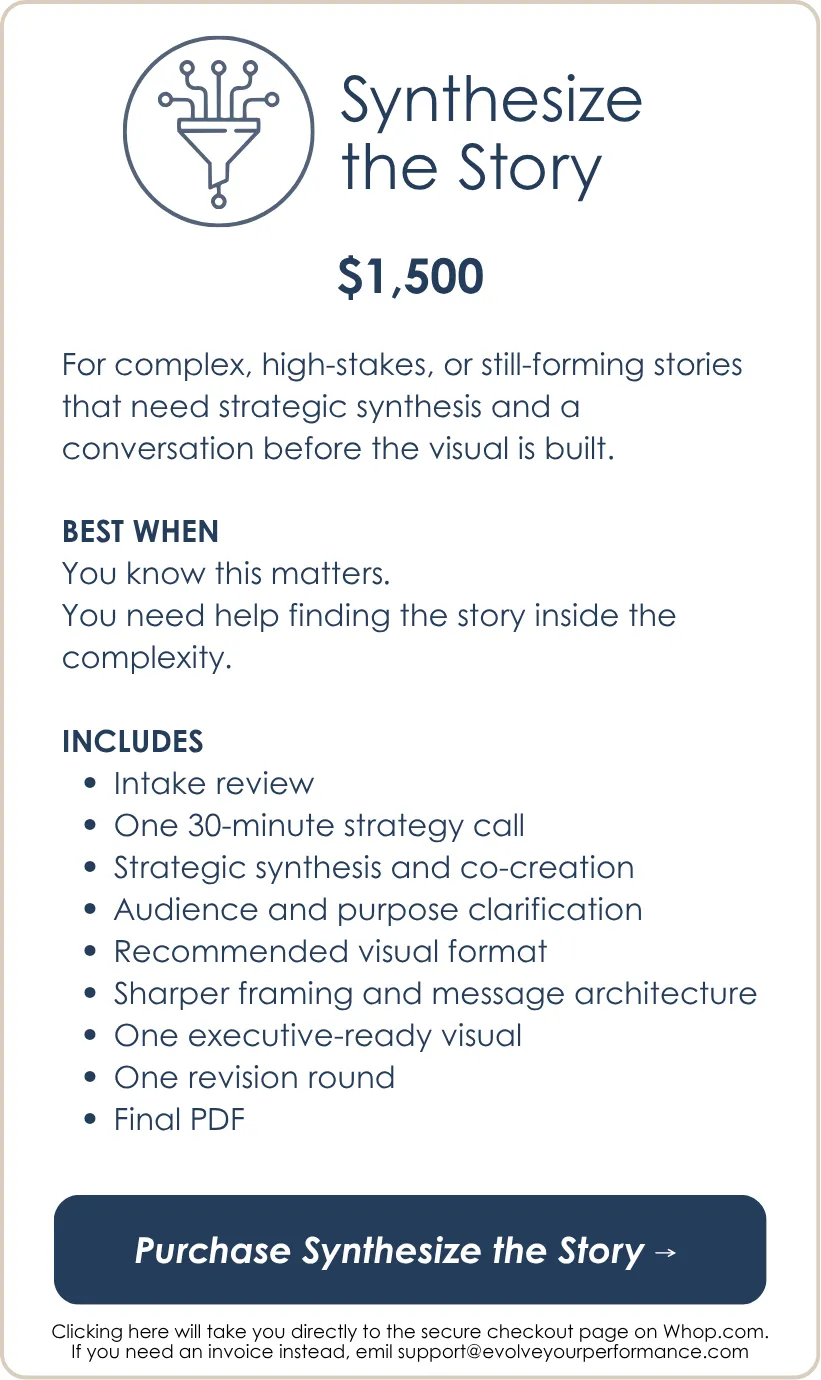
Choose based on how clear the story is right now.
Pick the level of support that matches where you are in the process.
WHAT HAPPENS NEXT
The process is simple.
NOTE: Work begins after payment and completed intake are received.


A few questions before you choose
What if we already have a strategic plan?
That helps.
A strategic plan explains the strategy.
A strategic alignment visual helps people see the strategy, understand how the pieces connect, and locate their role in moving it forward.
If the plan is already clear and you need it visualized, choose Visualize the Story. If the plan needs stronger hierarchy or a clearer alignment path, choose Shape the Story.
What if we already have a strategy deck?
A deck can be useful, but decks often spread the story across too many slides.
A visual anchor gives the room one shared reference point. It helps people see the whole picture without flipping back and forth through the deck to remember how everything connects.
What if leaders say they are aligned, but execution still feels scattered?
That is often a sign that people are aligned around language, but not around meaning.
They may agree on the words while interpreting the priorities, tradeoffs, sequence, or ownership differently.
A strategic alignment visual can make those interpretations visible so the room can resolve them before they become execution drag.
What if we have too many strategic initiatives?
That is common.
The goal is not to make every initiative look equally important.
The goal is to create a clear view of how the initiatives relate to the strategy, where they fit, what they support, and what needs priority attention.
Some initiatives may belong in the visual. Others may belong in backup materials, a roadmap, or an implementation tracker.
What if different teams need to see themselves in the strategy?
That is a strong fit for this ukse case.
The visual can show the shared direction while also making contribution clear by function, team, workstream, stakeholder group, or initiative area.
The point is not to make every team the center.
The point is to help each team see how its work supports the larger direction.
What if the strategy is still evolving?
Then the visual may need to support alignment before finalization.
Sometimes the point of the room is to test the strategy, clarify priorities, surface tensions, or confirm how the work should be sequenced.
That can still be strategic alignment. The visual simply needs to be built for the stage you are in.
What if this is for a retreat or offsite?
This can work well for a retreat, offsite, leadership session, planning conversation, or strategy rollout.
The visual can serve as the anchor for discussion, reflection, prioritization, and next-step clarity.
If you also need facilitation support, that can be scoped separately.
What if the strategy involves sensitive tradeoffs?
Sensitive tradeoffs need clean framing.
The intake form asks what language must stay exactly as written and what can be clarified. This matters when priorities, funding, staffing, restructuring, stakeholder commitments, or leadership tensions are involved.
For sensitive or high-stakes alignment work, Synthesize the Story is usually the better fit because the framing matters as much as the design.
What if my content is messy?
Messy content is normal.
If the content exists but needs structure, choose Shape the Story.
If the story itself is still hard to frame, choose Synthesize the Story.
If the content is already clear, choose Visualize the Story.
What if I have too much information?
That is common.
The goal is not to fit everything onto one page.
The goal is to create the right view for the conversation.
Some details may belong in the visual. Others may belong in backup materials, an appendix, or the full report.
What if I choose the wrong package?
The package is based on how much thinking support you need before the visual gets built.
If your request appears to be significantly outside the package you selected, we will flag that before the build begins and recommend the right adjustment.
The goal is to make sure the work is scoped correctly so the final visual is useful.
Is this just graphic design?
No.
The final artifact is visual, but the work is not just design.
It is message structure, sensemaking, visual hierarchy, and executive communication.
The goal is not just a better-looking page.
The goal is a clearer conversation.

Ready to help the room see the same path forward?
You do not need another strategy conversation where people nod in the room and then carry five different versions of the plan into execution.
If the strategy matters, the room needs a visual anchor strong enough to show the vision, connect the initiatives, clarify contributions, and support coordinated movement.
Choose the level of support that fits where your alignment story is now, and we will help turn the complexity into an executive-ready visual people can actually use.
Still thinking it through? Check out the How it Works page to learn more and download the free guide.
We make complexity visible.
We help people see the patterns.
We turn understanding into action.
That's executive storytelling.
An Evolve Your Performance offering.
© 2026 Evolve Your Performance, LLC
All rights reserved.